Alphabet Logic didn’t begin as a matchmaking system. It began as a pattern-finding habit.
Long before I thought about relationships or romance, I enjoyed organizing characters into groups. One of the earliest ways I did this was by grouping them according to the number of letters in their names.
Later, something new happened — I began creating rival groups. Not random rivalries, but ones based on patterns.
And surprisingly, this idea started with Pokémon.
For example:
Arceus belonged to the six-letter group.
Sceptile belonged to the eight-letter group.
Most Pokémon names naturally fell into five-, six-, seven-, and eight-letter categories. Four-letter names were rare, and nine-letter names were even rarer.
Out of all these groups, I found myself especially drawn to comparing two at a time. Managing all of them felt complicated, but two groups created a clear rivalry.
The most interesting rivalry became six letters vs. eight letters.
The six-letter group had legendary powerhouses like Arceus, Dialga, and Palkia.
The eight-letter group had strong and diverse Pokémon like Giratina, Sceptile, Blaziken, and Swampert.
It felt balanced:
One side represented legendary power.
The other represented diversity and strong competitors.
Imagining which group would win became surprisingly addictive.
From Letter Counts to First Letters
Later, my focus shifted from letter counts to first letters.
Instead of grouping by length, I started grouping characters by their starting alphabet. Each letter became its own “family.”
Once again, I focused mainly on two groups instead of all of them.
Those two groups were A and S.
The S group had a large variety of characters.
The A group had fewer, but extremely powerful ones.
This created a meaningful balance:
Variety vs. Strength.
Quantity vs. Power.
Even when I explored this idea across other media—anime, tokusatsu, and more—I kept returning to A vs. S.
At that stage, my thinking was still focused on competition and battles, not romance.
When Rivalry Became Pairing
Years later, my thinking evolved.
Instead of asking,
“Which group wins?”
I began asking,
“What if the rivals became partners?”
That single question changed everything.
Pairing A and S characters together felt emotionally satisfying. It turned opposition into harmony. It felt more complete than rivalry ever did.
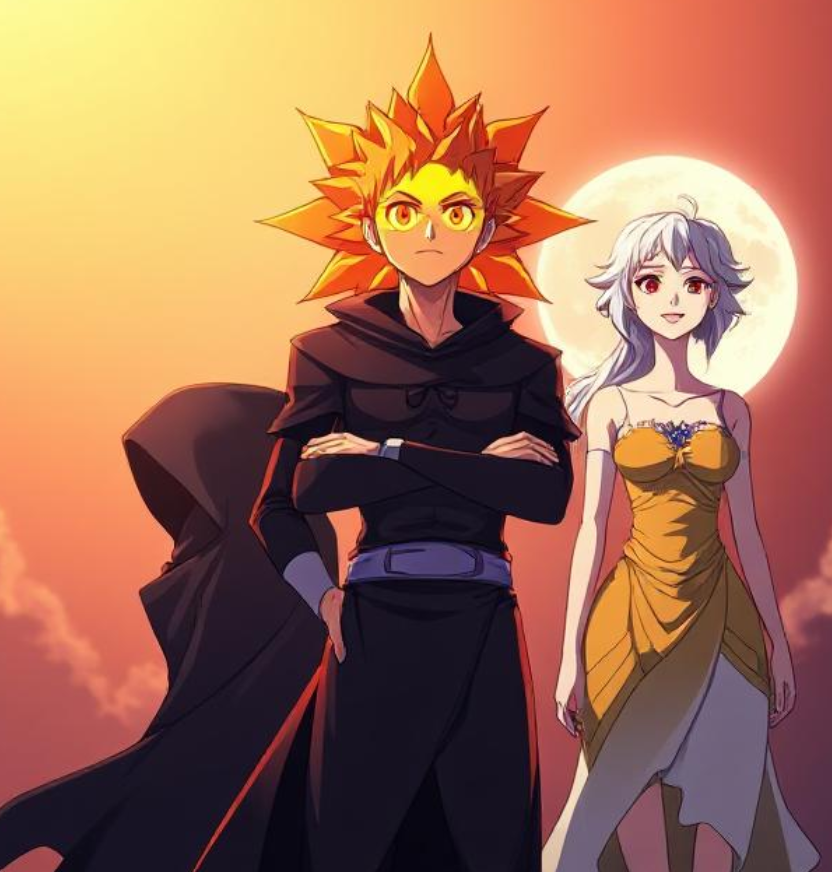
This became the true beginning of Alphabet Logic.
I started pairing characters whose names began with A and S. Same-gender pairings felt like alliances or friendships. Opposite-gender pairings felt harmonious and romantic.
These pairings were rare, and that rarity made them feel special.
Expanding the System
Eventually, I began thinking about other possible pairings.
One that stood out to me was H and M. I noticed it in characters like Shin-chan's parents, Hiroshi and Misae, and the pairing stuck with me.
For a while, I thought H–M pairings might be common - but they weren't. Just like A–S, they were relatively rare. Still, I liked the pattern, so I kept it.
From there, I began expanding the system to include other alphabet pairs, though I don't remember the exact chronological order in which they appeared.
Completing the Alphabet Pairings
If A pairs with S, then moving one letter forward gives a sequence of pairings:
B with T
C with U
D with V
E with W
F with X
At this point, you might expect the pattern to continue with G and Y- but this is where things changed.
When I was watching anime, I found myself wanting to pair K with Y instead.
The reason was simple: in many anime series, names beginning with K and Y appear quite frequently. The pairing felt natural to me in that context.
There was also a practical reason. Some letters were already paired:
H was paired with M
A was paired with S
If I paired K with either M or S, it would create contradictions in my system. Pairing K with Y solved that problem and felt aesthetically right to me.
So K–Y became one of the system's intentional exceptions.
The I–O Pair
Next came I and O.
This pairing felt intuitive for multiple reasons. First, there's the simple conceptual connection: input and output - I and O often appear together in computing and logic systems.
But storytelling also influenced this decision.
Two anime pairings reinforced the idea:
Ichigo and Orihime (Bleach)
Izuku and Ochako (My Hero Academia)
Seeing these examples made the pairing feel even more meaningful. So I–O became part of the alphabet logic system.
Later Pairings
From there, more pairings formed gradually.
J paired with N, an idea that came to me while developing my own stories.
That left L and Z, which naturally became a pair later in the process.
By this point, most letters had partners - but the system still evolved.
When T Replaced B
Originally, I paired B with T, but that changed when I started watching Kamen Rider Ichigo.
I really liked the pairing of Takeshi Hongo and Ruriko Midorikawa. That led me to notice other T–R pairings, and I became fond of that combination.
So I replaced the earlier pairing and made T–R official in my system.
That left B without a partner temporarily.
The Remaining Letters
Later, I paired G with P.
There wasn't a specific anime example behind this one - it was more of an instinctive decision. Sometimes patterns form not from observation but from intuition, and this was one of those cases.
Finally, only B remained.
Since the English alphabet has 26 letters, everyone eventually gets a partner. The only letter left to pair with B was Q, which led to the final pairing:
B–Q
And with that, the alphabet logic system became complete with these pairings:
A–S
B–Q
C–U
D–V
E–W
F–X
G–P
H–M
I–O
J–N
K–Y
L–Z
R–T
Every letter received exactly one partner.
Looking Back
Alphabet Logic may seem unusual, but it grew naturally from a love of patterns.
What started as grouping Pokémon by letter count slowly evolved into grouping by first letters, then rivalries, then partnerships.
It became more than a game. It became a creative framework.
Even now, I see it less as a rigid rule and more as a symbolic system that connects patterns, balance, and storytelling.
Sometimes, the smallest habits—like organizing names by letters—end up shaping how we think creatively for years.